Overview
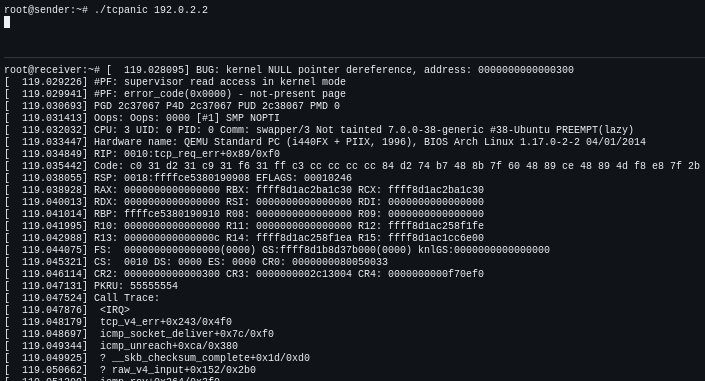
Ikotas Labs independently discovered a bug in the way the Linux kernel handles TCP connections. We call it TCPanic. On affected systems, incoming TCP traffic alone can cause the entire host to halt. This is not limited to a LAN or another constrained environment: it is a practical attack that works over the public internet.

The vulnerability is tracked as CVE-2026-99288. A fix is available in the Linux 7.3.4 stable release.
How TCP traffic can bring down a server
When the Linux kernel receives a packet, it looks up the corresponding TCP connection. While one CPU is performing the lookup, another can release the connection record and reuse the memory for a new request. The lookup can then mistake the new record for the original one. The kernel can panic when it tries to use a listener that the new record does not reference.
The general prerequisite is an unpatched, multi-core Linux server that receives TCP traffic from an external source. No application login or user authentication is required.
Impact and fix availability
The bug affects TCP connections over both IPv4 and IPv6. Exposure depends on which unpatched Linux host receives the connection. A load balancer that terminates a connection and opens a separate one to a backend processes the original packets itself. If a containerized service receives the connection and its host kernel panics, every other service on that host goes down with it.
With the upstream fix, the kernel retries the lookup if the connection record is no longer in the table. The fix is also included in the mainline release candidate 7.4-rc2.
Security assessments for Linux-based products
Ikotas Labs researches vulnerabilities in the Linux kernel and other software. When assessing a Linux-based product, we identify which components receive external traffic and evaluate how a vulnerability could affect the product’s operation. To discuss an assessment, contact us.